
Introduction
Starting from version 4.1, TDM Digital Signage allows you to use the table element within your template design.
With this element, you can easily create tables by dragging an area in your layout and then configuring its properties in the Layout tab.
Here, you can define:
-
The number of rows and columns
-
Whether or not to display borders
-
Border thickness and color
-
Font style, alignment, and background color
In the Data tab, you can also link an external data source to automatically populate the table with live information.
This guide explains how to create and configure the table element within the template editor.
Requirements
To use the table element in the designer, you must have:
-
Access to Templates in the TDM Designer
How to Use the Table Element
-
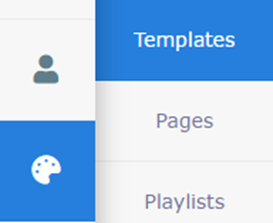
Open Content Creation from the left-hand menu and select Templates.
-
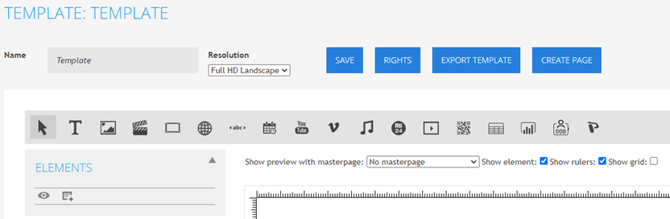
Create a new template or edit an existing one to open the template editor.
-
Select the Table element — this is represented by the table icon.

-
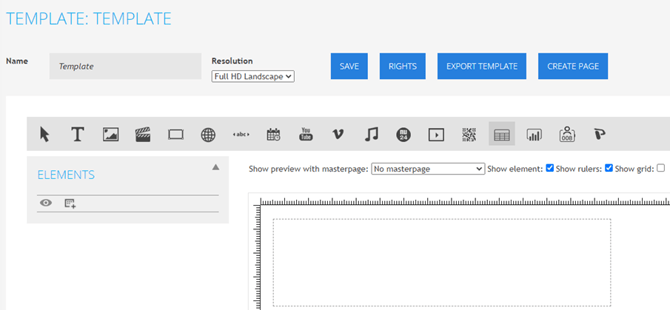
Click and hold the left mouse button, then drag to draw a frame where you want the table to appear in your design.
-
Release the mouse button to open a configuration pop-up for the table element. If you plan to load data from an external data feed, continue with all tabs. If you want to manually enter text, skip the settings in the Data tab.
Tab: General
-
Name: Enter a name for the element, e.g., Weather Information.
Tab: Layout
-
Transparency: Adjust the transparency of the table background.
-
Columns: Define the number of columns (e.g., 4).
-
Rows: Define the number of rows (e.g., 5).
-
Border: Enable or disable borders for the table.
-
Font Family: Choose the desired font.
-
Font Size: Set the text size.
-
Font Weight: Choose between regular or bold text.
-
Text Color: Set the text color.
-
Background Color: Choose a background color for the table (optional).
-
Text Alignment: Align text to the left, center, or right within the cells.
Tip: You can adjust the table’s size under Show positions, measured in pixels.
For example, if you’re designing in Full HD and want the table to fill the screen, enter the appropriate width and height values.
Tab: Data
-
Datasource: Select the external data source (e.g., Weather).
-
Table: Choose the top-level XML node (e.g., /weather).
-
Row: Choose the XML row level (e.g., /weatheritem).
-
Columns: Choose which values to display in the table, such as Date, High, Low, and Title.
Once you’ve completed the configuration, click Save. The pop-up will close, and the table will appear in your template editor.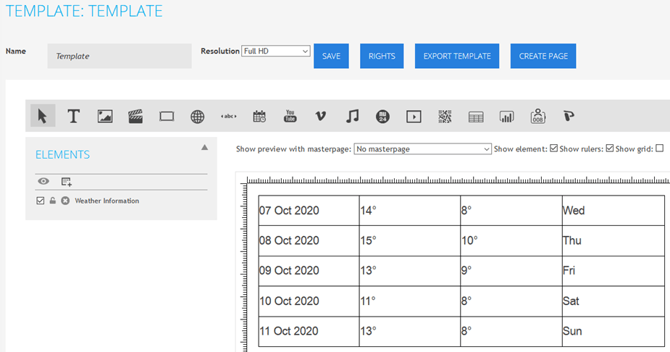
You have now successfully set up the table element. You can continue designing by adding more elements as needed. When finished, create a page based on this template and add it to your playlist.